Blog6 min read
What is a love room? A clear definition, Japanese origins and how it differs from a romantic hotel
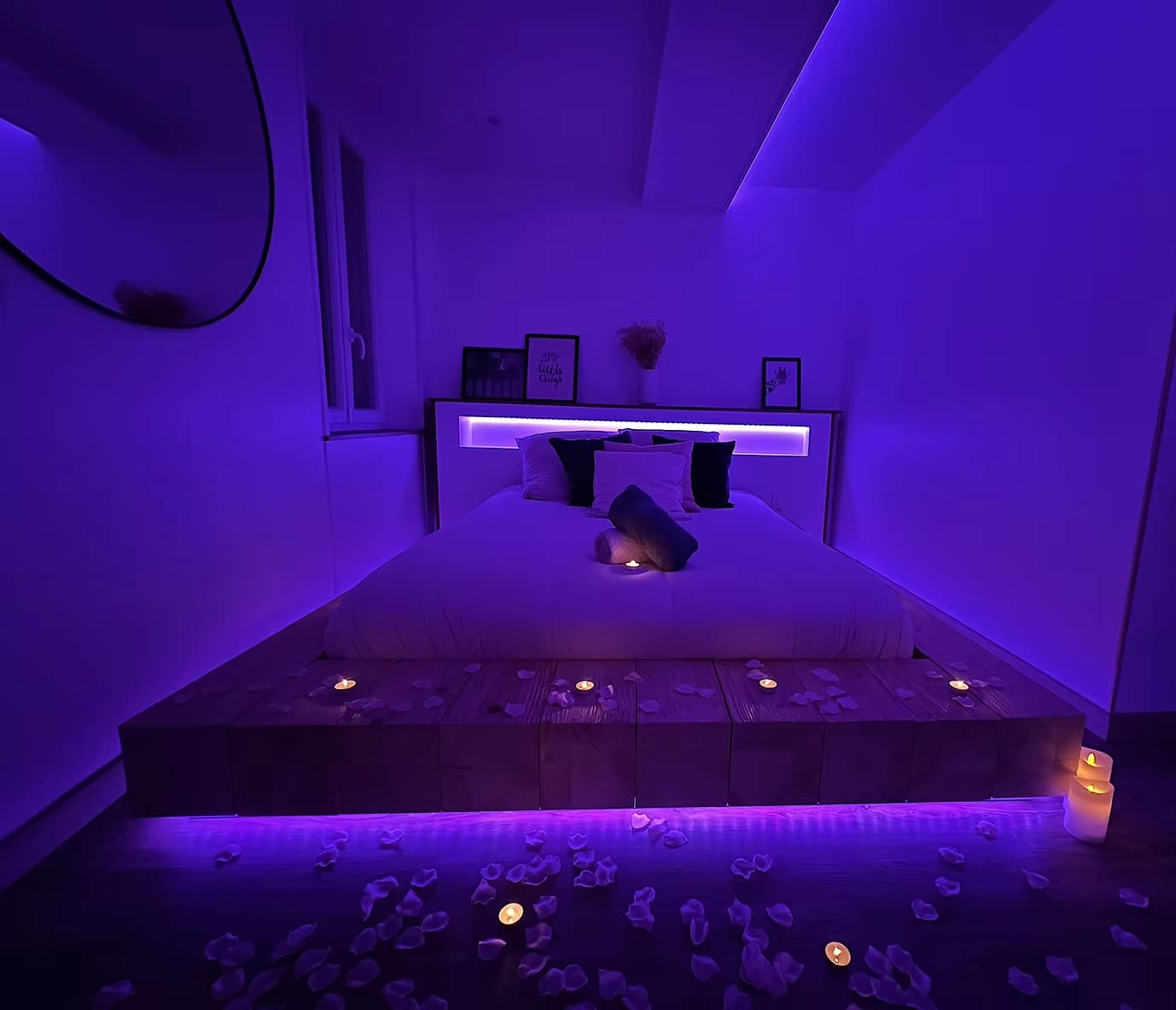
You've seen love rooms popping up on Instagram, somewhere between anniversary reels and marriage proposals, and you're wondering what they actually are. A hotel room with a bigger jacuzzi? A private spa you can sleep in? A marketing buzzword? A bit of all three, and, in a way, none of them.
Here's a clear, sourced, no-fluff definition. No superlatives, no overselling at every turn, and a proper look at where the concept actually comes from, which, spoiler, isn't France.
The short definition
A love room is a fully private accommodation designed from the ground up for two people. It's not a hotel room someone sprinkled rose petals on, it's a space built around one single use case: two people, a pause, nothing else.
In practice, a real love room ticks three boxes:
Total privacy, no shared corridor, no neighbour on the other side of a thin wall, no receptionist running into you in a bathrobe at 2 a.m.
Dedicated wellness equipment, jacuzzi, corner bath, hammam, sauna, multi-jet shower, dimmable mood lighting.
A stay scenario rather than just a room, lighting, music, add-ons (chilled bottle, grazing board, massage) are part of the product, not an upsell at the counter.
Where the concept comes from: a story that starts in Japan
Despite the French-sounding names many brands use, love rooms were not invented in Provence. The modern concept descends directly from Japanese love hotels, which themselves evolved from the chaya (茶屋), discreet tea houses of the Edo period (1600-1868) that already offered private rooms for quiet meetings between the tea services.
The real turning point came after World War II. In a rapidly urbanising Japan, apartments were small, walls were thin, and several generations often lived under the same roof. Couples needed somewhere of their own, even just for a few hours. The first dedicated venues appeared in the 1950s around Ueno, in Tokyo, and the format exploded in the 1970s, the first venue to carry the name "Hotel Love" opened in Osaka, and the label became a category of its own.
France only caught on in the 2010s, with a cultural twist. Where Japanese love hotels answered a need for space (young adults living with their parents well into their thirties, paper-thin walls), French love rooms answered a need for experience, stepping outside the routine, creating a memory, marking an occasion.
Love room vs hotel room: the real differences
This is the question we hear the most. Here are the actual differences, the ones that matter, not the marketing ones.
1. It's designed for one single use case
A hotel room has to work for everyone: business travellers, families, transit stays. A love room is designed for one thing: two people who want to be alone. Everything follows from that, the floor plan, the flow, the acoustics, the lighting, the equipment. Nothing in the room fights the main intention.
2. Acoustic standards and privacy
In a hotel, you hear the door next door, the lift, the room service cart at 7 a.m. In a proper love room, there's no neighbour, no shared corridor, no foot traffic. You arrive, you close the door, and the rest of the world goes away. It's the first thing guests actually notice, and usually the first thing they ask about when booking for a meaningful occasion.
3. Amenities are included, not upsold
In a "romantic" hotel, the jacuzzi is often an 80 € add-on for 30 minutes, tucked away in the basement, with three other couples queuing for the same slot. In a love room, the jacuzzi is in the room, yours, for the whole stay. Same goes for the hammam, the rainfall shower, the connected speaker, the mood lighting.
4. The experience is built in
A hotel sells you a night. A love room sells you a moment, the arrival, the ambience, the aperitif, the bath. Most venues let you pre-order extras (a chilled bottle, a grazing board, petals, a massage) so you don't have to coordinate anything on the day itself.
What to expect in a genuine love room
Amenities vary from one venue to the next, but here's what most real love rooms have in common, beyond the marketing brochure:
A large bed (king size, usually) with good linen and several pillows.
A private jacuzzi or whirlpool bath, ideally in the main room or directly adjoining the bedroom, not hidden in a separate bathroom.
A sauna, hammam or rainfall shower, at least one of the three, often all three.
Dimmable, multi-scene lighting (evening, bath, sleep).
A connected speaker for your own playlist.
A large screen with access to the main streaming platforms, underrated, but hugely appreciated on film-blanket-jacuzzi evenings.
A kitchenette or at least a fridge, a coffee machine and proper glassware.
Actual silence, not relative silence, actual silence. It's the hardest thing to deliver and the most important one.
A reliable signal: when a venue puts its amenities on the cover shot rather than the wallpaper, you're usually in the right place.
Who is it for, and when?
Love rooms aren't just for newlyweds or marriage proposals. The most common reasons guests book, in rough order:
A couple's anniversary, dating, married, civil partnership, whichever applies, the top occasion by far.
Just a pause together, no special reason, just the need to reconnect away from kids, work and notifications.
A marriage proposal, half the staging is already there.
A wedding night, a more private alternative to a standard hotel.
A gift, usually from a friend or relative, often via a voucher or a secure payment link.
Frequently asked questions
Can you book a love room by the hour?
In France, almost never. Unlike Japanese love hotels, French love rooms are sold by the night, or by the day in a longer format (for example 11 a.m. to 5 p.m.). It's a deliberate positioning: sell a long pause, not a quick passage.
Is it awkward to book one?
Not at all, and that's part of why the format has taken off. Booking happens online in a couple of minutes, no phone calls. On the day, many venues use a door code or a self-service key box, so you don't have to see anyone at check-in.
What should I bring?
Ideally: a playlist, a bottle (or order one as an add-on), something to nibble on if the venue doesn't offer a grazing board, and the usual basics. Everything else, linen, towels, toiletries, often a bathrobe and slippers, is provided. One piece of advice: don't over-program the stay. The whole point is to slow down.
How is a love room different from a private spa?
A private spa is usually a 1- to 2-hour slot in a wellness space that's yours for that window. A love room is an accommodation that contains a private wellness space. In other words: in a love room, you sleep over. In a private spa, you go home.
Are love rooms only for couples?
In practice, yes. They're designed for two, the terms of stay almost always say so, and the layout (one bed, no separation) doesn't really leave room for anything else. A few venues do welcome non-romantic duos (friends, mother and daughter, etc.), they're the exception, not the rule.
And what about us, in Le Beausset?
Suite B Spa is two love rooms in the heart of the Var, 20 minutes from Toulon and 15 minutes from Bandol. We built our two suites, Wood and Oak, around a simple idea: a love room should deliver on its promises without overselling. No fake marble, no gold candelabra, no overselling at every turn. A genuine, intimate cocoon, a jacuzzi for two in the main room, lighting you dial down as the evening goes on, and silence we actually guarantee.
If you'd like to see what that looks like in practice, our suites page shows both spaces in photos, and the options page lists what you can add à la carte (grazing board, bottle, massage). To book, just pick a date, it takes a minute, no phone call needed.
And if you'd rather ask a question before deciding, the contact page and the chat widget at the bottom right are there for that.